
In my previous post, I explained how I use points to book flights. In this post, I will show how I actually earn those points. I do not try to be fancy with points. I just use a few simple methods again and again. Over time, they add up and help me book flights and hotels using points instead of cash. Everything below is based on my own personal experience and is not travel, financial, or legal advice.
Here is one of the easiest ways I use almost every month.
1. Using Rakuten (Very Easy Way to Earn Extra Points)
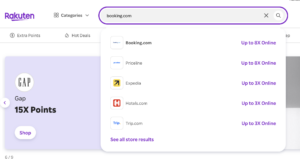
Rakuten is a shopping portal website that gives you a chance to earn cash back or American Express points when you shop at your usual online stores.
You just go to Rakuten first, find the store you want, click it, and then shop like normal.
If you have an American Express card that earns Membership Rewards points (like Amex Platinum), you can choose to earn Amex points instead of cash back on Rakuten. That is what I always do.
Also, you do not have to use an Amex card to pay. You can pay with any card you want. As long as your Rakuten account is set to earn Amex points, you will still earn the points.
How I Actually Use It
Whenever I book a place on Booking.com, I first check Rakuten.
If Rakuten is offering a bonus, I click the link from Rakuten to Booking.com and then book like normal.
For example:
-
Total stay on booking.com: $1200
-
Rakuten bonus: 8%
This gives me about 9600 Amex points (1200 × 8) just from using the Rakuten link to Booking.com.
On top of that, I also earn points from my credit card like normal.
In this case, I usually use my Citi Strata Premier, which earns 3x points on booking.com purchases.
So for the same $1200 booking, I also earn:
-
3600 Citi ThankYou points from the Citi Strata premier credit card. This has nothing to do with Rakuten. It is just the regular earning from the card.
So One Booking Earned Me:
-
9600 Amex points from Rakuten
-
3600 Citi points from my Citi Strata Premier
That is why I like this method. You are stacking points from two different places for the same purchase.
The Rakuten bonus usually ranges from 1% to 15%, depending on the season and whether the store participates in the Rakuten program.
One Small Thing to Watch
Before booking, I always do a quick check:
-
Open Booking.com directly in Chrome
-
Then open it again through Rakuten using a different browser (Safari or Firefox)
Sometimes the price through Rakuten is slightly higher (it is rare, but it happens). If the price is the same, I go with Rakuten. If not, I just book direct.
It Is Not Just for Hotels
Rakuten also works for many other stores.
So anytime I plan to buy something, I check Rakuten first.
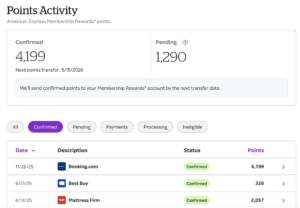
For example, if I want to buy a camera from Best Buy, I go through Rakuten first and earn extra points on that purchase too. The screenshot below shows an example of the points I earn through Rakuten from shopping online at Best Buy, Mattress Firm, and Booking.com.
2. Earning Points Through Credit Cards
This is the main way I earn points.
I keep it very simple. I just use the right card for the right type of spending.
How I Use My Cards
● Flights
I use Amex Platinum to book flights directly with airlines (5x points per dollar).
One exception: once a calendar year, I put one flight of at least $250 on the Chase IHG Premier, booked directly with the airline, to get its $100 statement credit. That benefit runs through December 31, 2027.
● Hotels and Airbnb
I use the Citi Strata Premier for hotels and Airbnb (3x points per dollar). Side note: I do not use it for IHG hotel stays.
Why not the Chase Sapphire Preferred, even though it also earns 3x on Airbnb stays? Because the points from the Citi Strata Premier transfer to the LifeMiles program, which is my favorite.
For Airbnb stays, I also earn an extra 1x Delta SkyMiles per dollar when I book through the Delta-Airbnb partnership page.
For IHG hotel stays I use the Chase IHG Premier (24x to 30x points per dollar, depending on elite status).
● Dining and Lyft
I use Chase Sapphire Preferred for restaurants (3x points per dollar) and Lyft rides (5x points per dollar).
● Grab Food in Southeast Asia
This depends on which country in Southeast Asia. In some countries such as Malaysia, Grab Food is coded as online grocery, so I use Chase Sapphire Preferred (3x points per dollar) in this case. In other countries such as Indonesia, Grab Food is coded as restaurants or takeout. In this case I use Wells Fargo Autograph (3x points per dollar). You may ask why I don’t use Chase Sapphire Preferred since it gives 3x on both online grocery and takeout. The answer is that I want to keep Wells Fargo dedicated to Grab purchases for simplicity, and also because Wells Fargo points are transferrable to the LifeMiles program, which is my favorite.
● Gas
I use either the Citi Strata Premier or the Wells Fargo Autograph for gas at the pump (3x points per dollar on both).
Why not the Chase Sapphire Preferred, even though it also earns 3x? Because the points from the Citi Strata Premier and the Wells Fargo Autograph transfer to the LifeMiles program, which, as I mentioned earlier, is my favorite.
● Supermarkets
I use the Citi Strata Premier for supermarkets and grocery stores (3x points per dollar).
● Uber, Grab, and Ground Transport
I use Wells Fargo Autograph for Uber, Grab, and ground transport like trains, subways, and buses (3x points per dollar).
● Car Rentals
I usually use Amex Platinum for rental cars (1x point per dollar).
Citi Strata Premier earns 3x points, but I still use Amex because the rental car coverage from Amex feels more reliable to me, so I value that more than the extra points. If you still own a car, the Chase Sapphire Preferred may be the better fit for your rentals, since its coverage is primary rather than secondary. I explain why I stay with the Amex Platinum anyway in my post on the most important credit card benefits to look for if you are a full-time traveler.
● Cell Phone Plans
I use Amex Platinum for cell phone plans (1x point per dollar).
Wells Fargo Autograph earns 3x points, but I still use Amex because it provides reliable phone insurance in case my phone is lost or damaged. Wells Fargo Autograph also offers phone insurance, but I prefer Amex’s coverage.
● Electronics and Appliances
I use the Amex Platinum for electronics and appliances (1x point per dollar).
This is another category where I give up points on purpose. I care about two things here. Extended warranty adds one year on top of the manufacturer warranty, and purchase protection covers the item if it is damaged or stolen in the first few months after I buy it. The Citi Strata Premier may add up to two years of extended warranty, but the coverage on the Amex Platinum has been more reliable for me when I have actually needed to use it. On a large purchase, that matters to me more than the extra points.
● Streaming Services
I use the Wells Fargo Autograph for streaming subscriptions such as Netflix (3x points per dollar).
The Chase Sapphire Preferred also earns 3x on select streaming services, so on the earning rate alone it would work just as well. I stay with the Wells Fargo Autograph for the same reason I gave earlier, which is that Wells Fargo points transfer to the LifeMiles program and Chase points do not.
One thing worth checking is that not every service earns the bonus rate. It applies to the larger, well known ones, and smaller or regional apps sometimes post at 1x instead. When I sign up for something new, I look at how the first charge shows up on my statement before I assume it is earning 3x.
This is also the easiest category to set and forget. Subscriptions renew on their own, so once the right card is on file, it keeps earning without me thinking about it again.
● Drugstores and Pharmacies
I use the Chase Freedom Flex for drugstores and pharmacies (3x points per dollar). None of my other cards earn a bonus in this category, and since Chase removed the foreign transaction fee on this card, I can use it at pharmacies overseas too. Just like with streaming services, I check how the first charge at a new pharmacy shows up on my statement. Outside the United States, some pharmacies inside malls or larger stores may not code as a drugstore, so they may earn only 1x.
The points earned on this card are Chase Ultimate Rewards points. Since I also have the Chase Sapphire Preferred, I move them to that account so I can transfer them to partners such as United MileagePlus, Air Canada Aeroplan, or World of Hyatt.
● Quarterly 5% Bonus Categories
I use the Chase Freedom Flex for whatever falls into its 5% rotating bonus categories that quarter (5x points per dollar on up to $1,500 in combined purchases each quarter). The categories change every quarter, so I activate them in the Chase app at the start of each quarter and check what they are before I pay. When a category overlaps with one of the cards above, such as groceries or restaurants, I switch to the Freedom Flex until I reach the $1,500 limit, then go back to my usual card.
As I mentioned above, I move these points to my Chase Sapphire Preferred account so I can transfer them to airline and hotel partners.
● Everything Else
For anything not covered above, I use:
Amex Blue Business Plus for US transactions only, since it has a foreign transaction fee (2x points per dollar).
Chase IHG Premier for foreign transactions (3x points per dollar).
A Faster Way to Look This Up
The list above is how I decide, but scrolling through a blog post every time you buy something is not practical. I turned the same logic into a tool that answers one purchase at a time. You pick the type of purchase and it shows the card I use, what it earns, and why I chose it over the other cards that would also work. You can find it here: Which Credit Card to Use.
If you are wondering why I hold these particular cards in the first place, I wrote a separate post about the benefits I look for in a credit card as a full-time traveler. Earning points is only one part of it. The insurance coverage, the lack of foreign transaction fees, and how the card behaves when something goes wrong overseas matter just as much to me, and that post explains how I weigh all of it together.
You may have noticed that I mentioned LifeMiles a few times above as my favorite program without really explaining why. I wrote a separate post that goes into it, and if your long haul flights run between the United States and Southeast Asia or Japan the way mine do, that is the one I would point you to. It covers why LifeMiles works so well for those particular routes, the mile ranges I look for in business class, and a few things about the site that are worth knowing before you try to book.