

When I first started this nomadic life, one thing really surprised me. Staying in hotels and furnished apartments around the world full time was actually much cheaper than renting or owning a home in the United States.
And the best part is everything is included. I do not have to think about electricity, water, internet, or any extra bills. It is all built into one price, which makes life a lot simpler.
That realization changed everything for me. It was a big reason why I decided to give up my condo in the U.S., sell my furniture and car, and fully commit to this lifestyle. Instead of spending a lot just to stay in one place, I now use that same money to live in different parts of the world and experience new places.
After doing this for years, I’ve figured out a few simple things that keep my accommodation costs low. If you are curious, keep reading.
Everything below is based on my own personal experience and is not travel, financial, or legal advice.
Pick Safe, High-Quality Cities with a Low Cost of Living for Longer Stays

One thing that made a big difference for me was choosing cities where I can live well without spending a lot.
Instead of moving too often, I usually stay 1 to 3 months in places that offer a good balance of cost, comfort, and daily life.
Some places that worked really well for me:
- Chiang Mai, Thailand
- Hua Hin, Thailand
- Bangkok, Thailand (Thonglor area)
- Ho Chi Minh City, Vietnam (District 2, Thao Dien area only)
- Danang, Vietnam
- Nha Trang, Vietnam
- Hanoi, Vietnam
- Luang Prabang, Laos
- Siem Reap, Cambodia
- Bali, Indonesia (Ubud and Sanur)
- Nagasaki, Japan
- Osaka, Japan (Joto Ward district only)
- Busan, South Korea
- Antalya, Turkey (outside the historic old town)
These places are not just affordable. They are comfortable to live in. You can find good apartments, reliable internet, decent food, and everything you need for day-to-day life. Staying longer in places like these helps reduce costs, avoid burnout, and makes full-time travel feel more stable.
If you are wondering what a full year of this lifestyle could cost, I built a free calculator for a year of slow travel in Asia. You pick where you want to go in Southeast Asia, Japan, and South Korea, enter your yearly budget, and it shows how long to stay in each country and what the whole year could cost, based on my own spending.
Avoid Touristy Areas

I try my best to avoid touristy areas when I am picking a place to stay. Those areas are built for vacationers and short term tourists who are only in town for a few days. My stays are usually a minimum of 1 month, so I do not need to be in the middle of everything.
Staying away from the tourist attractions actually works out well for me in two ways. First, I get more peace and quiet in a safe, residential area. I am not dealing with crowds, noise, or areas packed with people just passing through. Second, it saves me money. Safe areas outside the city center are almost always cheaper than the areas right next to the main attractions. So I end up hitting two birds with one stone, a quieter place to live and a lower cost.
That said, I do not just pick any random neighborhood outside the center. I make sure the area is safe and still has good access to public transportation, supermarkets, and restaurants that are not catering to tourists. As long as those things are covered, I am comfortable, and I usually end up feeling more like a resident than a visitor.
Join Expats Groups for Local Tips

Facebook expat groups can be a great resource when looking for a place to stay in a new city. Join trusted groups for the city you’re visiting and ask locals or long-term residents for recommendations. Just be careful because scams are out there, so only use well-known and reliable groups. I stick to private groups that thoroughly vet members when they join, since that alone filters out a lot of the scammers and spam accounts.
I personally use these groups mainly to find out what neighborhoods are good and what properties are good, not necessarily to find a real estate agent. I also use them when I need to find a reliable doctor, dentist, or other services like that. Getting honest opinions from people who actually live there has helped me narrow down where to look before I even start searching for a place, and it also helps me find trustworthy people for other things I need while I’m there.
Start With a Short Stay, Then Look for Short-Term Apartments in Person

This approach does not work the same in every city, but in some it works really well. Danang, Vietnam is a good example. A lot of the good properties there are not even listed on Airbnb or Booking.com.
If I am in a city where good properties are not well listed online, like Danang city in Vietnam, one thing I often do is book a hotel for the first few days when I arrive in a new city. This gives me time to get familiar with the area before committing to a longer stay. Once I settle in a bit, I go out and look for short-term apartments in person. This way, I can see the neighborhood, check if the location feels right, and look at the actual apartment before agreeing to anything. It has helped me avoid places that looked good online but didn’t feel right in person.
Stay Longer to Get Airbnb Discounts
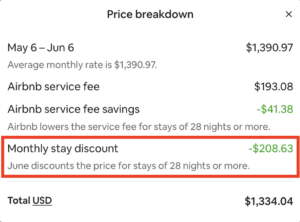
One of the easiest ways to save money is to stay longer in one location. Many booking platforms, like Airbnb, offer discounts if you book a place for 28 days or more. It’s a great way to cut costs, especially if you want to take your time exploring the city and settling into everyday life.
To avoid any issues, I am picky about which listings I book. Here is what I look for before I commit to a place:
- Superhost status only
- A minimum review score of 4.8 out of 5
- At least 50 reviews
- I read every single review, not just the recent ones
Being this careful takes a bit more time upfront, but it has helped me avoid a lot of headaches and land in places that actually match what was advertised.
On top of the discount, using the right card to pay for your Airbnb booking can also earn you points. Cards like the Citi Strata Premier and the Chase Sapphire Preferred earn 3x points on Airbnb bookings.
You can stack even more value by joining the Delta and Airbnb partnership program. Just add your Delta SkyMiles number to your Airbnb profile, and you will earn 1 Delta mile per dollar spent, on top of the points you already earn from your Citi Strata Premier or Chase Sapphire Preferred.
I have a full post on how I earn points for flights and hotels while traveling full time, you can check it out here: How I Earn Points for Flights and Hotels While Traveling the World Full Time.
One warning though. If you are booking an Airbnb property located outside the US, I recommend switching the currency from USD to the local currency before you pay. Airbnb sometimes charges extra for the conversion if you leave it in USD. Just make sure your credit card does not charge a foreign transaction fee before you do this. If you follow my strategy and use the Citi Strata Premier or the Chase Sapphire Preferred, you do not have to worry about a foreign transaction fee when paying in a foreign currency.
Stick with One Booking Platform (Booking.com)

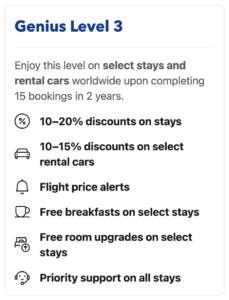
I recommend sticking with one hotel booking platform (like Booking.com). The reason? You can build up a status and earn perks. For example, if you get to Genius Level 3 on Booking.com, you can score 20% off a lot of hotels. Plus, they might offer other sweet benefits like free room upgrades or early check-ins.
Just like with Airbnb, I am picky about which properties I book. Here is what I look for:
- A minimum review score of 8 out of 10
- At least 50 reviews
- I read every single review before I book
On top of the discount, I also stack points on every Booking.com stay using Rakuten shopping portal and my Citi Strata Premier card. Here is how it works. Before I book, I check Rakuten first to see if there is a bonus for Booking.com. If there is, I click through the Rakuten link to Booking.com and book like normal. Rakuten pays out in Amex Membership Rewards points, and the bonus usually ranges from 1% to 15% depending on the season.
On top of that, I pay with my Citi Strata Premier, which earns 3x points on Booking.com purchases. So for the same booking, I am earning Amex points from Rakuten and Citi ThankYou points from my card, both from the same purchase.
Before I actually book, I always double check the price. I open Booking.com directly in Chrome, then open it again through Rakuten using a different browser like Safari or Firefox. Sometimes the price through Rakuten is slightly higher, though it is rare. If the price is the same, I go with Rakuten. If not, I just book direct.
I have a full post that breaks this down in more detail, along with the other cards I use for different types of spending, you can check it out here: How I Earn Points for Flights and Hotels While Traveling the World Full Time.
Negotiate Directly with the Owner for Your Next Stay

If you stayed at a place, liked it, and plan to return, consider reaching out to the owner directly next time. Booking through a platform usually includes extra fees, so you might be able to get a better price by booking with them directly. It’s always worth asking!
If your Airbnb stay was perfect, most of the time the host will give you their contact through WhatsApp. I always try to communicate through the Airbnb message system instead, just in case something goes wrong and I need to file a claim. That said, having the WhatsApp contact can come in handy if you want to negotiate a better deal directly, especially if you plan on going back to the same property in the future.
Just keep in mind there is some risk with this. When you deal directly with the host, you lose the protection layer that Airbnb provides. It is worth considering based on the situation, but go in knowing that trade-off. Personally, I prefer dealing through a known platform like Airbnb or Booking.com just to get peace of mind in case something goes wrong. If you use the Citi Strata Premier or Chase Sapphire Preferred for your Airbnb and Booking.com stays, both cards offer some type of protection if something goes wrong with the booking and you need to file a dispute. The amount saved is not always worth the unnecessary stress.
Use IHG Points & Keep an Eye Out for Points Sales

IHG has a lot of good hotel options in Southeast Asia and Japan, which is where I spend most of my time. If you have the Chase IHG Premier card, you get a perk where if you book 4 nights with points, you get the 4th night free. This helps stretch points a lot, especially for longer stays. The nice part is that this benefit keeps working for even longer trips. For example, if you stay 8 nights, you get 2 nights free, and if you stay 16 nights, you get 4 nights free. Also, IHG sometimes runs 100 percent bonus deals when buying points. I just keep an eye out for those and grab them when they show up. When the numbers work out, buying points during one of those promos and using them for stays can end up being cheaper than paying cash. Another thing worth mentioning is that once you reach 40 nights in a calendar year with IHG, you can choose lounge access as one of your rewards. It is valid for the rest of that year plus the entire following year, and those 40 nights do not have to be consecutive.
For a deep dive into exactly how I use IHG points to get maximum value as a full-time traveler, including when to buy points, how to stack bonuses, and how I build elite status on a budget, read my post: How I Get Insane Value From IHG Points as a Full-Time Traveler.
Use Hyatt Points and World of Hyatt Loyalty Program

The Hyatt loyalty program is my favorite hotel program because they do not use dynamic pricing for award bookings. Hyatt uses an award chart with fixed point rates, which makes it much easier to plan and find great value compared to other hotel chains that change their point prices all the time. If you have a Chase Sapphire Reserve, you’re in luck. You can transfer your Chase Ultimate Rewards points to Hyatt and get some amazing deals. For example, you can book a room in a high-cost city for as low as 3000 Hyatt points if you travel during the off-season. The 3000 point rate is for Category 1 hotels during off-peak nights. It is a great way to save a lot without paying out of pocket. On the Hyatt booking site, you can check each hotel’s calendar to find dates when rooms are available for just 3000 points. The best part is that when you book a room with Hyatt points, you usually get free cancellation, so you can change your plans without worry.
Chase now transfers Ultimate Rewards points to Hyatt at 4:3 for Sapphire Preferred and Ink Business Preferred cardholders, so 10,000 Chase points become 7,500 Hyatt points. The change took effect for all of these cardholders on October 1, 2026. Chase Sapphire Reserve and Sapphire Reserve for Business cardholders still transfer at 1:1, and since Chase lets you move points between your own accounts, points earned on other Chase cards can go to Hyatt at 1:1 through a Reserve card. Bilt also transfers to Hyatt at 1:1 until December 31, 2026, and switches to 4:3 on January 1, 2027.
When I am not sure whether a stay is worth using points, I run it through my Hyatt Points Calculator. It accounts for the 1:1 and 4:3 transfer ratios, Hyatt points sales, and the points a paid stay earns with your elite status, then shows whether paying cash or using points comes out ahead for that stay.
Travel Off-Peak to Save More

Since you’re full-time traveling, you have the luxury of being flexible with your plans. Use that flexibility to your advantage and avoid traveling during peak seasons. Not only will you find cheaper rates on accommodations, but the places will also be less crowded, a win-win!
My Asia nomadic life calculator does this for you. It plans Japan for December through February and Bali for September, when there are fewer tourists and lower prices.
Use Your Free Night Credits to Fill the Gaps Between Trips

Between longer stays, I sometimes need a night or two to bridge the gap. Maybe I am transiting from one city to another, or I just want one night near the airport before an early flight. Instead of paying out of pocket, I use the free night credits and statement credits that come with the credit cards I already carry.
Here is what I use:
- Chase Sapphire Preferred: offers a $100 annual hotel credit when you book a stay through the Chase Travel portal.
- Citi Strata Premier: offers a $100 Annual Hotel Benefit on a single hotel stay of $500 or more (before taxes and fees) when booked through Citi Travel.
- Chase IHG Premier: gives a free anniversary night worth up to 50,000 points at IHG hotels.
- Amex Platinum: gives up to $300 in statement credits, twice a year, for prepaid bookings at Fine Hotels + Resorts or The Hotel Collection properties through Amex Travel. The first $300 covers January through June, and the second $300 covers July through December.
These credits are easy to forget about since they just sit there quietly until you use them. I make it a habit to match them up with the in-between nights I need anyway, so I am not paying cash for something that is already covered.
If you want to go deeper on this topic, I have a post on how I use the right card for the right type of spending: How I Earn Points for Flights and Hotels While Traveling the World Full Time. I also have a post that breaks down my favorite travel cards and what to look for: The Most Important Credit Card Benefits to Look for If You Are a Frequent Traveler.