
Everything below is based on my own personal experience and is not financial, legal, or tax advice.
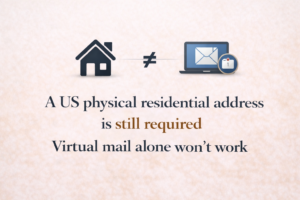
Under the USA PATRIOT Act, all U.S. financial institutions are required to collect a valid physical residential address when you open or maintain a bank account in the USA. This requirement still applies even if you are living or traveling full-time outside the U.S.
As a full-time US traveler, both inside and outside the US, you can manage your mail and meet the requirements of US financial institutions and the USA PATRIOT Act by setting up two addresses: a physical residential address and a mailing address. Both addresses must be in the same state, but they do not have to be in the same city. Almost all financial institutions require a physical residential address for both new and existing accounts, but they also allow a separate mailing address where you can receive your mail. Here is how you can set this up effectively.
The Mail Forwarding Service Solution is NOT ENOUGH. It is only part of the complete solution
Mail forwarding services are designed to manage your mail efficiently, no matter where you are in the world. These services provide you with a mailing address where all your mail can be sent. Here’s how it works:
- Mail Scanning: When mail arrives at your forwarding service, they scan the envelopes and notify you. This allows you to decide what to do next.
- Digital Access: You can view scanned images of your mail online, and if necessary, request the service to open and scan the contents of specific letters.
- Mail Forwarding: If you need a physical piece of mail, the service can forward it to your location anywhere in the world.
- Shredding or Archiving: For unwanted mail, you can ask the service to shred it, or archive it for future retrieval.
How to Choose the Right Mail Forwarding Service: Due Diligence Is Critical
Picking a mail forwarding service is not like signing up for a streaming subscription. You are handing over access to your financial statements, legal documents, tax notices, credit card replacements, and other sensitive correspondence that you would not leave on a park bench. The company you choose deserves the same level of scrutiny you would apply to a bank.
Do not use a third-party mail forwarding service. Period. A third-party service is any company that does not handle your mail itself and instead passes it off to another company, a local P.O. box operator, or a contractor to do the actual work. You signed up with one company but strangers you never vetted are opening your bank statements and handling your most sensitive documents. No matter how professional their website looks or how low their price is, if they outsource the handling of your mail to anyone else, walk away.
The only type of company you should use is one that operates its own in-house facility with its own staff. This means a company that is a specialist in mail forwarding, has its own secured physical location, employs its own trained staff, and handles every step of the process internally from receiving your mail to scanning it to forwarding it. No middlemen. No subcontractors. No exceptions.
Here is what to verify before signing up:
- Make sure the company is an authorized USPS mail receiver. This is not something to assume. A legitimate mail forwarding specialist should be a USPS-authorized Commercial Mail Receiving Agency (CMRA). This means they are officially recognized by the postal service to receive and handle mail on your behalf. If a company cannot confirm this, move on.
- Confirm that the mail service address is recognized for legal purposes such as a driver’s license, voter registration, IRS filings, and insurance. Escapees RV Club’s mail forwarding service in Texas, Florida, and South Dakota is a good example of this.
- Confirm they accept packages from all major carriers, not just USPS. Your mail forwarding service should be able to receive deliveries from FedEx, UPS, DHL, and Amazon in addition to regular USPS mail. This matters more than most people realize. Banks, brokerages, and government agencies do not always send things by standard mail. Some send important documents and replacement cards via FedEx or UPS overnight, and if your service cannot accept those deliveries you will miss them entirely.
- Ask directly whether any part of the mail handling is outsourced. A reputable company will answer this question clearly and confidently. If the answer is vague or evasive, that tells you everything you need to know.
- Verify that employees go through background checks and formal training. These are not optional extras for a company handling your financial mail. They are the minimum acceptable standard.
- Confirm the facility has real physical security measures in place. Your mail should be processed in a controlled, secured environment with accountability at every step. I personally recommend visiting the facility in person before committing to a service. Most people choose a mail forwarding service based in the same state as their physical residential address, which means you likely have an opportunity to stop by during one of your U.S. visits. Seeing the operation with your own eyes tells you more in five minutes than any website or review ever could.
- Read reviews from full-time travelers, expats, and RVers who have used the service for years. Short-term users rarely encounter the situations that expose a service’s weaknesses. You want feedback from people who have dealt with time-sensitive mail, overseas forwarding, and sensitive financial documents over an extended period.
One more thing worth knowing about street addresses: Many mail forwarding services advertise that they offer a real street address rather than a P.O. Box, and some people assume this automatically satisfies the physical residential address requirement for banks and brokerages. It does not. Financial institutions have systems in place to distinguish between residential addresses and commercial mail handling operations, regardless of how the address looks on paper. Even if a particular bank accepts it today, that can change when they audit their records. For more on how banks determine what qualifies as a physical address, why a mail forwarding street address does not meet that requirement, and how to set up your addresses correctly to stay compliant with U.S. financial institution requirements, read my post: How to Keep US Bank Accounts While Living Abroad.
Escapees RV Club’s mail forwarding service supports domicile in Texas, Florida, and South Dakota, and I recommend Escapees Mail Service for residents of any of these three states. Their address is recognized for legal purposes including a driver’s license, voter registration, IRS filings, passport, and insurance. If you reside in another state, you will need to do your own due diligence and research carefully to choose the right company to manage your mail.
Setting Up a Physical Residential Address
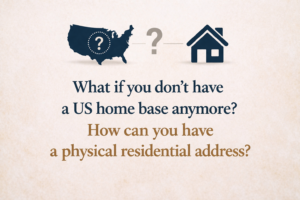
While mail forwarding services solve the problem of managing mail, a physical residential address is still required to comply with US financial institution requirements. Here is how you can manage this:
- Use a Family or Close Friend’s Address: Choose the home of a trusted family member or close friend as your physical residential address. This is usually the place you stay at when you visit home between trips. The physical residential address is required to satisfy the requirements of US financial institutions, but mail will not be delivered here if you set the mailing address to your mail forwarding service. Almost all financial institutions in the US offer the option to have a separate mailing address in addition to your physical residential address. The mailing address is where you receive your mail.
- Separate Physical residential and Mailing Addresses: Use your mail forwarding service’s address as your mailing address. This ensures that any important mail is routed directly to your mail forwarding service, where you can manage it digitally. Keep in mind that both addresses must be in the same state, but they do not have to be in the same city. This gives you flexibility in choosing a mail forwarding service that works best for you while still meeting the requirements of U.S. financial institutions.
FAQ: What About Driver’s License, Voter Registration, Jury Duty, Insurance, Passport, and the IRS?
Once you have your mail forwarding service and physical residential address set up, a few common questions come up about whether these addresses actually hold up beyond just satisfying your bank.
Escapees RV Club’s mail forwarding service is recognized by the states of Texas, Florida, and South Dakota as a valid physical address for a driver’s license, voter registration, and insurance, and it’s also recognized by the IRS and the U.S. State Department as a valid physical address in all three states. You are required to be a member of Escapees RV Club to sign up for the mail service, but you don’t need to own an RV to join. The organization works with full-time travelers and RVers establishing domicile every day, and they offer guidance on the domicile process itself if you have questions specific to your situation. This means you may use their mail service address as your residence address.
**Jury Duty:** This one depends on whether you are dealing with state or federal jury duty.
State jury duty: If you’re domiciled or a resident of Texas, a member of Escapees RV Club, and using their mail forwarding service as your address of record for your driver’s license, voter registration, and IRS filings, that same address can eventually get pulled for jury duty too. The local county may offer a jury duty exemption for Escapees RV Club members who are traveling, and the organization is familiar with this process since they work with members facing it regularly. Keep in mind this exemption isn’t automatic. You still need to call the county in Texas that summoned you and request the exemption yourself. They can point you in the right direction, but they aren’t the ones filing the exemption on your behalf.
Federal jury duty: This exemption does not carry over to federal jury duty, since states have no jurisdiction over federal courts. If you receive a federal jury summons while overseas, you will need to contact the court directly and ask about postponing your service. There is no blanket exemption for full-time travelers at the federal level, so this has to be handled case by case with a phone call or email.
Quick Summary of Address Setup:
| Purpose | Mailing Address | Residence Address |
|---|---|---|
| Banks, credit cards, brokerage accounts | Escapees RV Club’s mail service | Family member or trusted friend |
| Driver’s license, voter registration, insurance, IRS, passport, and other legal purposes | Escapees RV Club’s mail service | Escapees RV Club’s mail service |
For more on how your physical residential and mailing addresses interact with banks, brokerages, credit cards, and credit reports as a full-time traveler, digital nomad, or expat, including which address appears on your bank and credit card statements, which zip code to use when asked for verification, which address appears on your credit report, and why all of this matters, read my post: How to Keep US Bank Accounts While Living Abroad.
Key Consideration
-
Sign Up for Paperless Options: Whenever possible, enroll in paperless billing and statements to reduce the amount of physical mail you receive. This minimizes what needs to be handled by your mail forwarding service.
Why This Solution Works
- Convenience: With a mail forwarding service, you do not need to worry about missing important mail while traveling.
- Compliance: Using a family or close friend’s address as your physical residential address ensures compliance with the physical residential address requirements of US financial institutions.
- Legal recognition: The mail forwarding service’s address can also be used for state-level requirements like a driver’s license, voter registration, and insurance, as well as federal requirements like IRS filings and passport applications, provided the company you choose is recognized for these purposes in your state.
- Flexibility: The mail forwarding service’s ability to scan, forward, or archive mail gives you the flexibility to access your mail from anywhere in the world.
- Security: Trusted mail forwarding services maintain high standards of security to protect your sensitive documents. Do your due diligence and research carefully to choose the right company to manage your mail.